Caregiver & Next-of-Kin
Feature Detail
Description
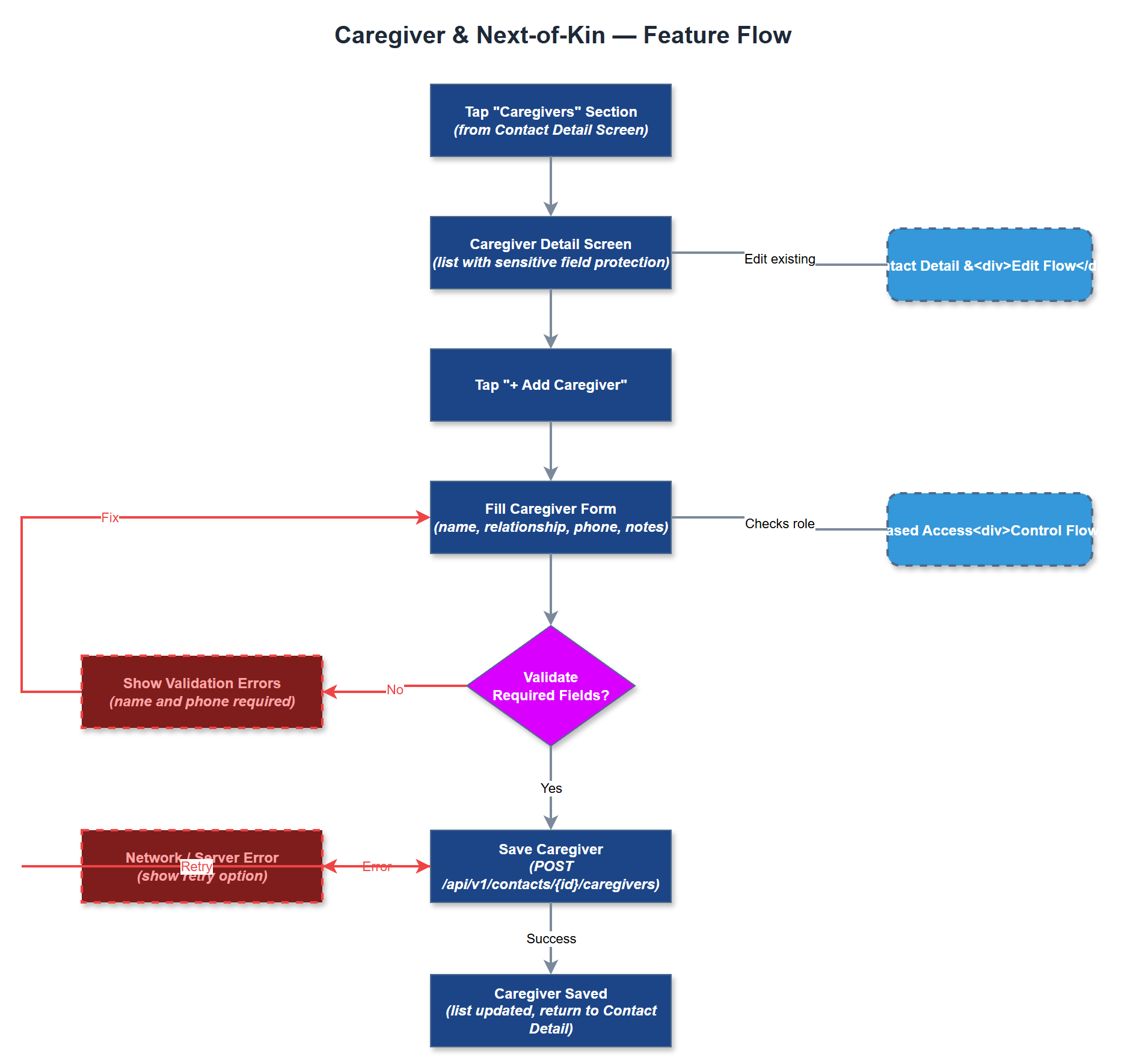
The Caregiver & Next-of-Kin feature allows peer mentors and coordinators to record and access emergency contact information and caregiver relationships for a given contact. Each contact can have one or more caregivers or next-of-kin linked to their profile, with fields for name, relationship type, phone number, and any relevant notes. The feature is particularly important for contacts with complex care situations where knowing who to contact in an emergency is critical. Data entry is simple and accessible, and caregiver records are displayed clearly within the contact detail screen with appropriate sensitive field protections applied.
User Flow
Analysis
Many of the contacts supported by peer mentors are elderly, have disabilities, or live alone, making next-of-kin and caregiver information essential for safety and continuity of care. Without this data in the app, peer mentors and coordinators must rely on informal knowledge or separate systems, creating gaps that can have serious consequences in emergency situations. Centralising caregiver information within the platform ensures it is always accessible during an active interaction and is kept up to date by the people closest to the contact. For organisations such as NHF, which serves contacts with cognitive disabilities and post-stroke conditions, this feature is a direct risk mitigation measure. Barnekreftforeningen explicitly identified a caregiver/next-of-kin database as a first-phase need, underscoring its priority across the partner organisations.
Caregivers are stored in the `contact_caregivers` table with a foreign key to `contacts`. The API exposes caregiver records as a nested array on the contact response and via dedicated endpoints (`/api/v1/contacts/:id/caregivers`) for CRUD operations. In Flutter, the caregivers section is rendered as an expandable card within the contact detail screen, listing each caregiver with name, relationship, and phone. An add/edit bottom sheet handles caregiver creation and updates. The relationship type field uses a predefined dropdown (spouse, parent, child, sibling, carer, other) to ensure data consistency. Phone numbers must be stored and displayed with the sensitive field readout warning applied. BLoC manages caregiver list state independently from the parent contact state to allow targeted refreshes without reloading the entire contact object.
Components (37)
Shared Components
These components are reused across multiple features
Service Layer (9)
Data Layer (12)
Infrastructure (7)
User Stories
No user stories have been generated for this feature yet.